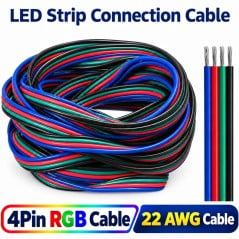
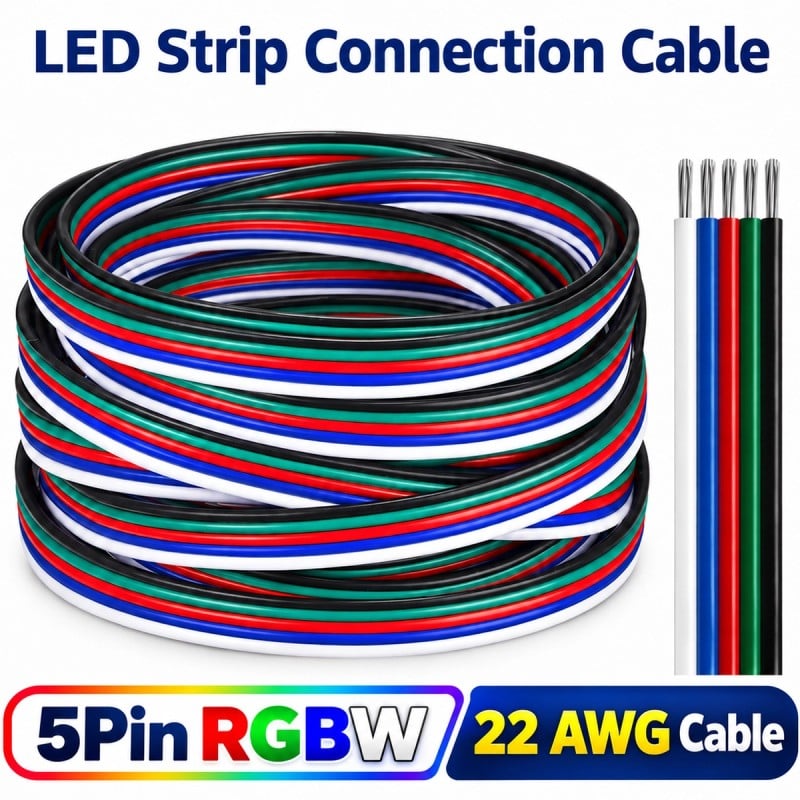
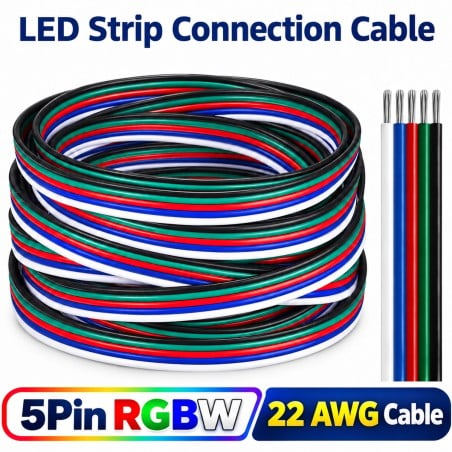
Five conductors for RGBW: carries the five connections of an RGBW LED strip: the common positive and the four red, green, blue and white channels, each on its own wire.
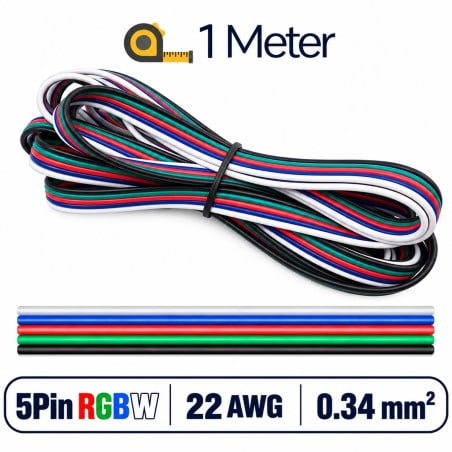
Five different colours: the conductors are black, green, red, blue and white: identify each wire at a glance and maintain the same order from the strip to the controller.
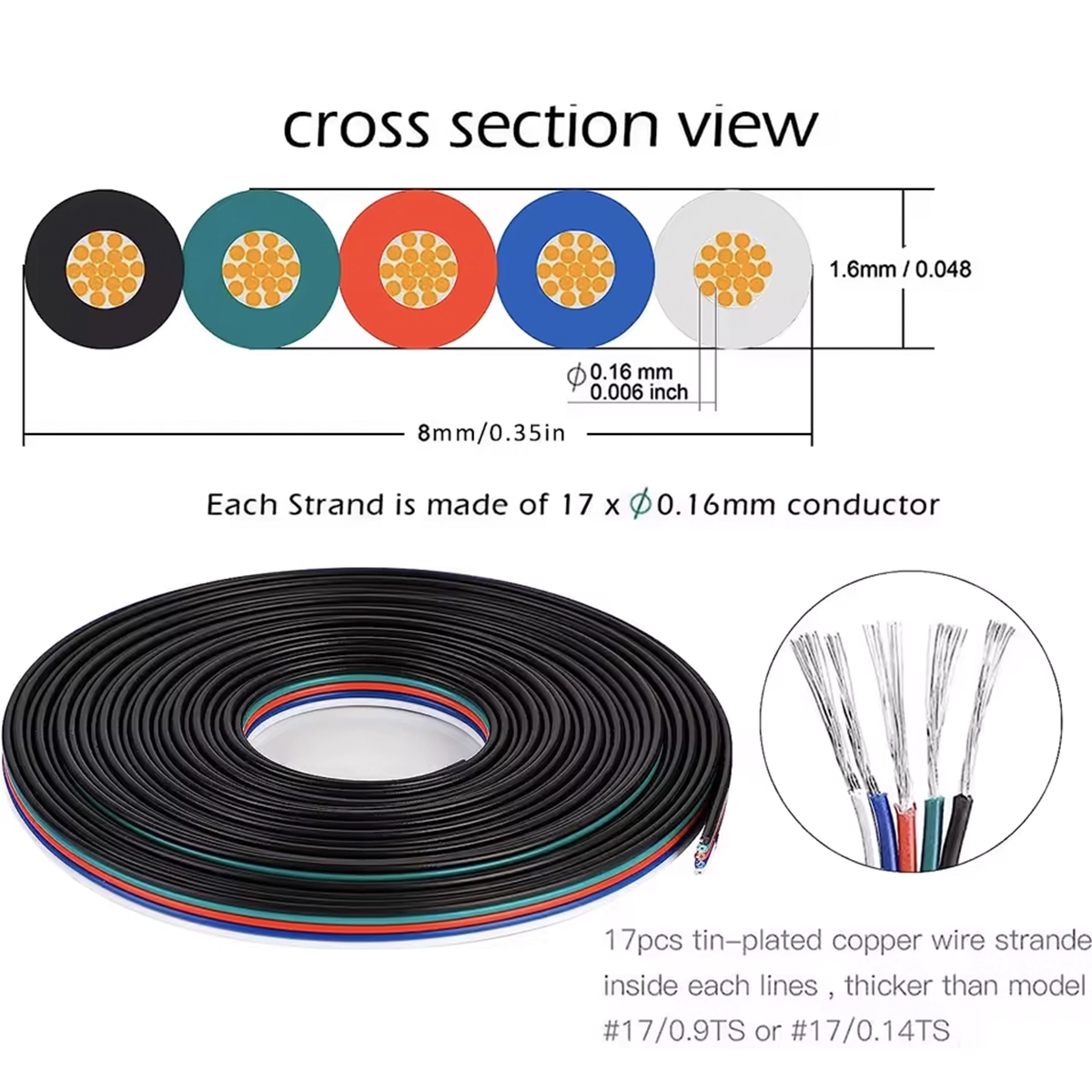
22 AWG cross-section: each conductor has a cross-section of 0.34 mm² (22 AWG) and consists of 17 strands measuring 0.16 mm: it stays flexible and bends without breaking.
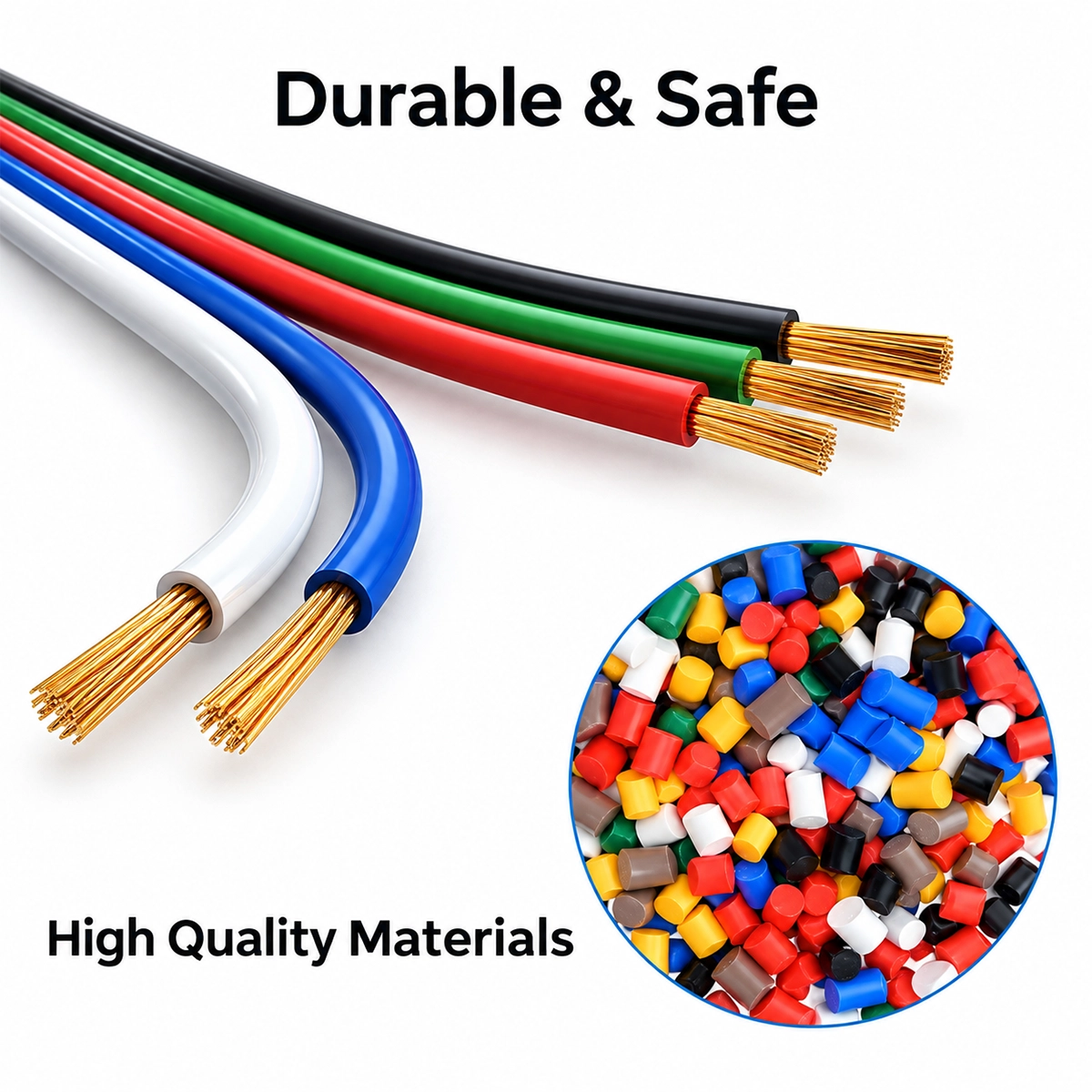
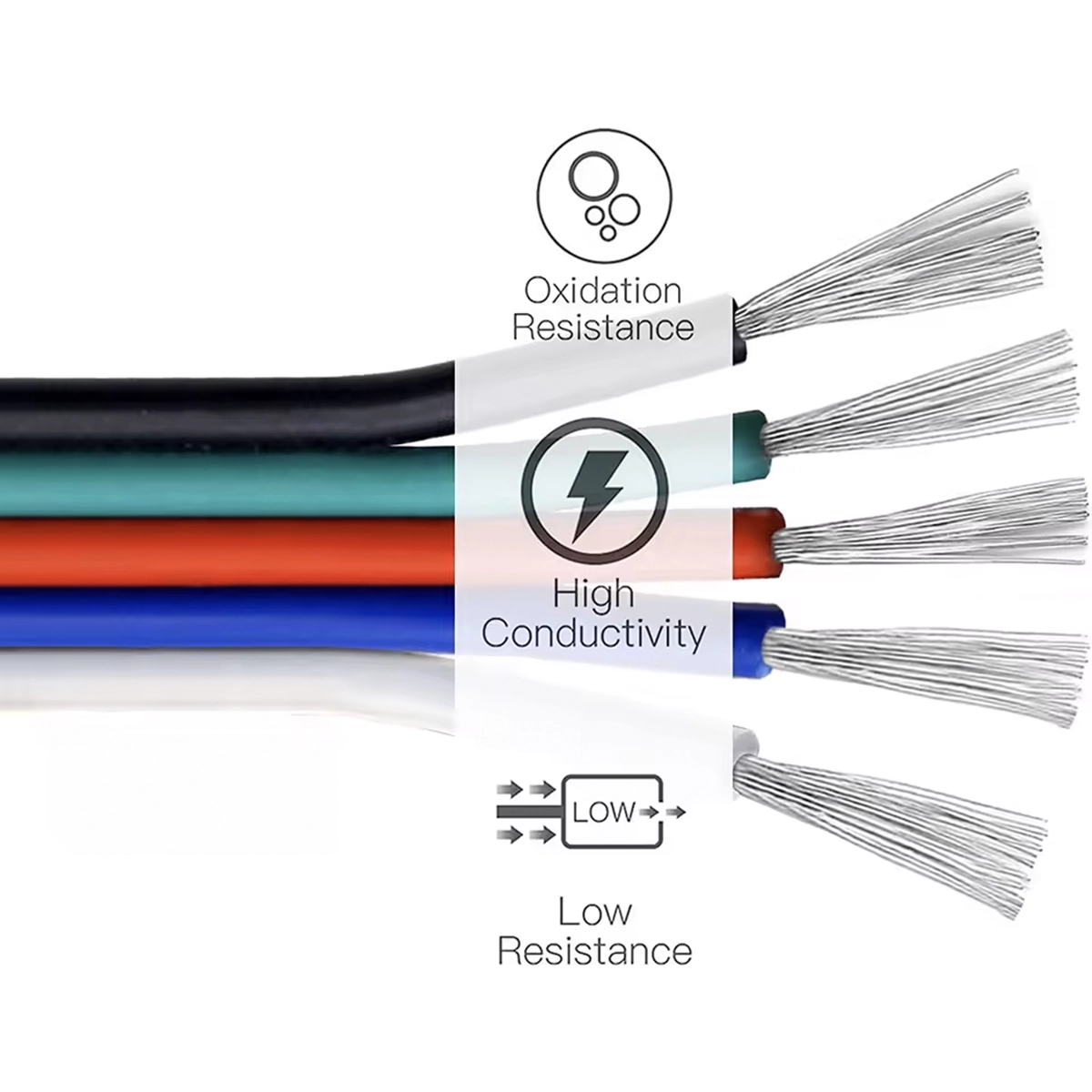
Tinned copper: the strands are made of tinned copper, which resists oxidation over time and readily accepts solder when you solder the cable to the strip's pads.
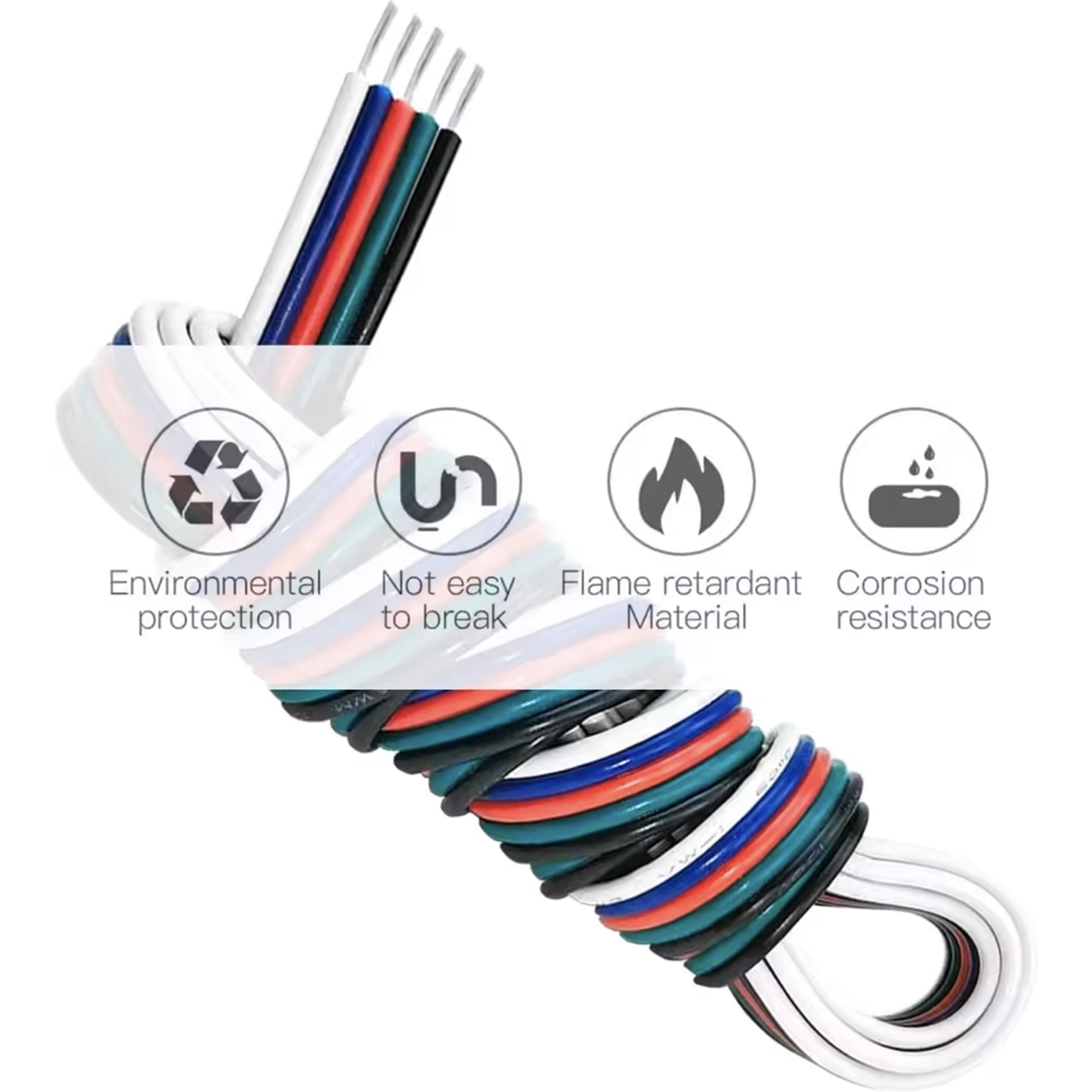
PVC insulation: each wire has its own flame-retardant PVC sheath; the sheath is printed with AWM 1007, 22 AWG, VW-1, 80 °C and 300 V.
8 mm flat cable: the five wires sit side by side in a ribbon 8 mm wide and 1.6 mm high, which fits easily into profiles and cable trunking, behind furniture and under wall cabinets.
Separable wires: the conductors can be pulled apart at the ends, so you can route each wire to its terminal or solder pad without cutting the insulation of the others.
1, 3 or 5 metres: choose the length you need from 1, 3 and 5 metres: a short length for a nearby connection, or a long one to position the controller further from the strip.
Unterminated ends: the cable comes without connectors: solder it to the strip, secure it in the controller's screw terminals or insert it into a 5-pin quick connector.
Extension between strip and controller: position the RGBW controller further from the strip, join two sections around a corner or across a doorway, and run the channels from one cabinet to another.
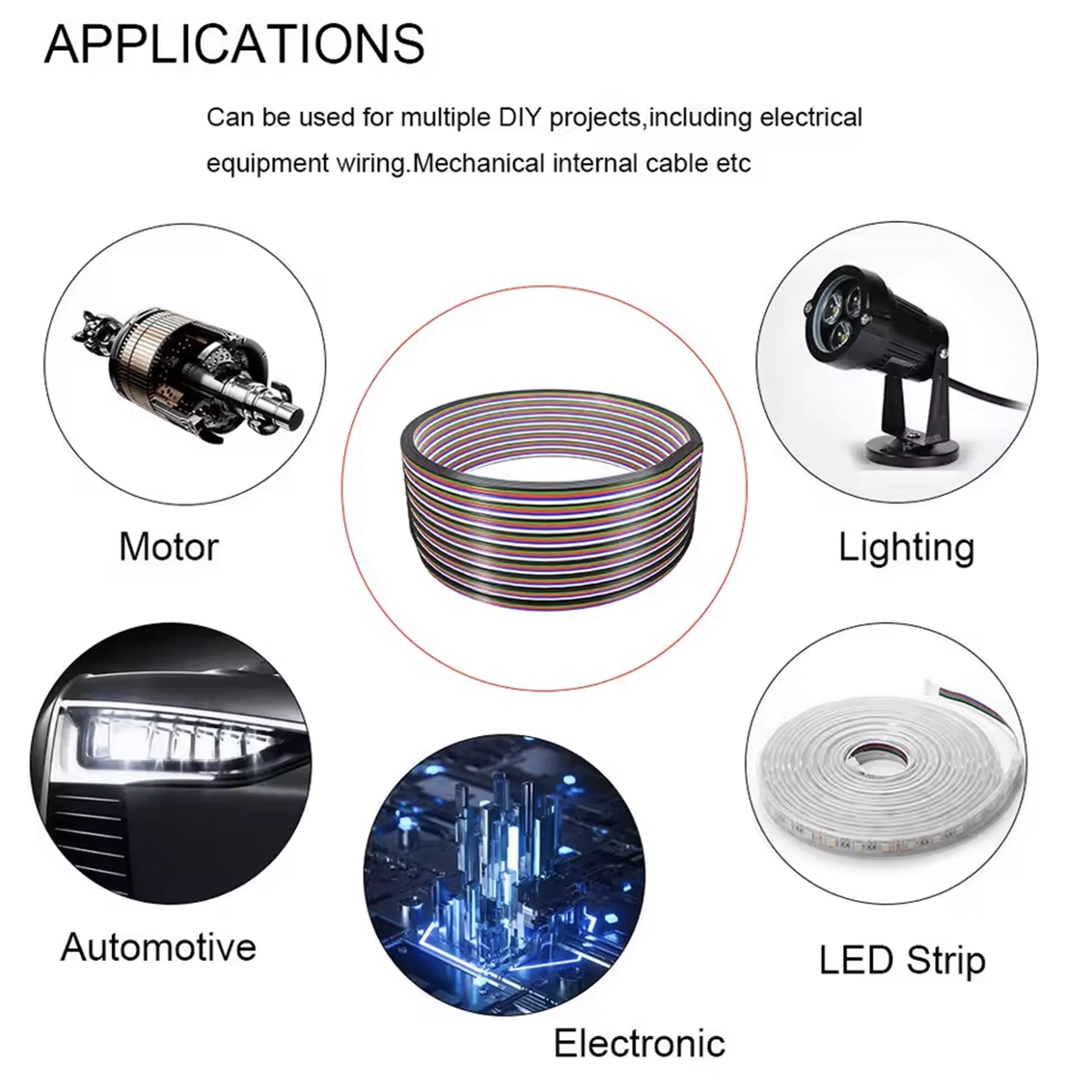
For LED strips and more: designed to connect RGBW LED strips, it is also suitable for other multi-conductor wiring, such as wiring in electronic devices, motors and lamps.
Uniform lighting: with high-power strips and long runs, keep the cable as short as possible and supply power at multiple points to keep the light uniform right to the end.
Passive accessory: no app, no protocol: the cable does not connect to WiFi. Strip, controller and power supply are sold separately.
Secure payments: cards, PayPal, bank transfer, and installments
Delivery within 48 hours: Free shipping on orders over €150 across Europe
Easy 14-day returns: follow the steps to get your refund
5-core 22 AWG tinned copper RGBW flat cable for LED strips and controllers
The 5-pin RGBW flat cable connects an RGBW LED strip to its controller, or two sections of strip together, and carries the common positive and the red, green, blue and white channels on five separate wires. The conductors are different colors, black, green, red, blue and white, so you maintain the same order from one end to the other. Each wire has a cross-section of 0.34 mm² (22 AWG) , is made of 17 strands of tinned copper and is insulated with flame-retardant PVC. The strip is 8 mm wide and 1.6 mm high and passes easily through profiles and conduits. The ends are free, without connectors: you solder them, tighten them in the terminals or insert them into a quick connector. You can find it in three lengths: 1, 3 or 5 meters .
17-strand tinned copper resists oxidation and conducts well
Inside each sheath are 17 0.16 mm strands of tinned copper . The tin layer protects the copper from oxidation, which over time blackens the bare wires and worsens the contact, and makes soldering easier: the soldering iron immediately adheres to the strands and the pads of the strip. Copper conducts current well with low resistance , and the thin strands make the cable flexible: you can bend it into corners and loop it around furniture without it breaking. When stripping one end, twist the strands before clamping them in a clamp, so that no loose wire can touch the neighboring conductor.
Where to use: RGBW LED strips, lamps, small motors and electronics
This cable is designed for 5-pin RGBW LED strips : you can use it as an extension between the strip and the controller, for example, when the controller is in a cabinet or box and the strip runs under cabinets, along a ceiling groove, or behind the TV. It's also useful for resuming the strip after a corner, door, or window, extending the five channels from one section to another. With a Tuya WiFi RGBW controller, you can control color and white from the app. Since it's a multicore cable for low voltage , it's also suitable for other wiring: lamps, small motors, and electronic devices. It's not a cable for 230V home electrical systems.
0.34 mm² cross-section, 22 AWG, in an 8 mm wide and 1.6 mm high ribbon
The drawing shows the cable cross-section: five side-by-side conductors—black, green, red, blue, and white—in a strip 8 mm wide and 1.6 mm high . Each conductor has a cross-section of 0.34 mm² , corresponding to 22 AWG , and is made up of 17 strands of 0.16 mm. The low profile fits into aluminum LED strip profiles, under baseboards, and in narrower conduits. To connect it to the strip without soldering, use a 5-pin RGBW solderless connector the width of your strip. The maximum current of the cable is not indicated: with powerful strips and long runs, keep the cable short and monitor the voltage drop.
Flame retardant PVC sheath, 300 V and temperature up to 80 °C
Each conductor has its own flame-retardant PVC jacket. The cable ratings are printed on the jacket: AWM 1007, 22 AWG, VW-1, FT1, 80°C, and 300V . VW-1 and FT1 are flame-retardant ratings for insulated wires, which verify that the jacket does not spread fire. The 300V and 80°C ratings are ample for a 12 or 24V LED strip. The PVC remains soft and can be stripped with standard wire strippers, and the wires can be separated by hand at the ends. If the cable is exposed or needs better protection, there is also a jacketed cable for RGBW LED strips ; among the accessories and connectors for LED strips, you will find quick connectors, terminals, and power supplies.
Follow the markings printed on the strip and on the controller and always use the same color for the same terminal, from one end of the cable to the other.
The maximum current is not specified. With powerful strips and long runs, keep the cable as short as possible and route the power from multiple points.
Five conductors for RGBW: carries the five connections of an RGBW LED strip: the common positive and the four red, green, blue and white channels, each on its own wire.
Five different colours: the conductors are black, green, red, blue and white: identify each wire at a glance and maintain the same order from the strip to the controller.
22 AWG cross-section: each conductor has a cross-section of 0.34 mm² (22 AWG) and consists of 17 strands measuring 0.16 mm: it stays flexible and bends without breaking.
Tinned copper: the strands are made of tinned copper, which resists oxidation over time and readily accepts solder when you solder the cable to the strip's pads.
PVC insulation: each wire has its own flame-retardant PVC sheath; the sheath is printed with AWM 1007, 22 AWG, VW-1, 80 °C and 300 V.
8 mm flat cable: the five wires sit side by side in a ribbon 8 mm wide and 1.6 mm high, which fits easily into profiles and cable trunking, behind furniture and under wall cabinets.
Separable wires: the conductors can be pulled apart at the ends, so you can route each wire to its terminal or solder pad without cutting the insulation of the others.
1, 3 or 5 metres: choose the length you need from 1, 3 and 5 metres: a short length for a nearby connection, or a long one to position the controller further from the strip.
Unterminated ends: the cable comes without connectors: solder it to the strip, secure it in the controller's screw terminals or insert it into a 5-pin quick connector.
Extension between strip and controller: position the RGBW controller further from the strip, join two sections around a corner or across a doorway, and run the channels from one cabinet to another.
For LED strips and more: designed to connect RGBW LED strips, it is also suitable for other multi-conductor wiring, such as wiring in electronic devices, motors and lamps.
Uniform lighting: with high-power strips and long runs, keep the cable as short as possible and supply power at multiple points to keep the light uniform right to the end.
Passive accessory: no app, no protocol: the cable does not connect to WiFi. Strip, controller and power supply are sold separately.